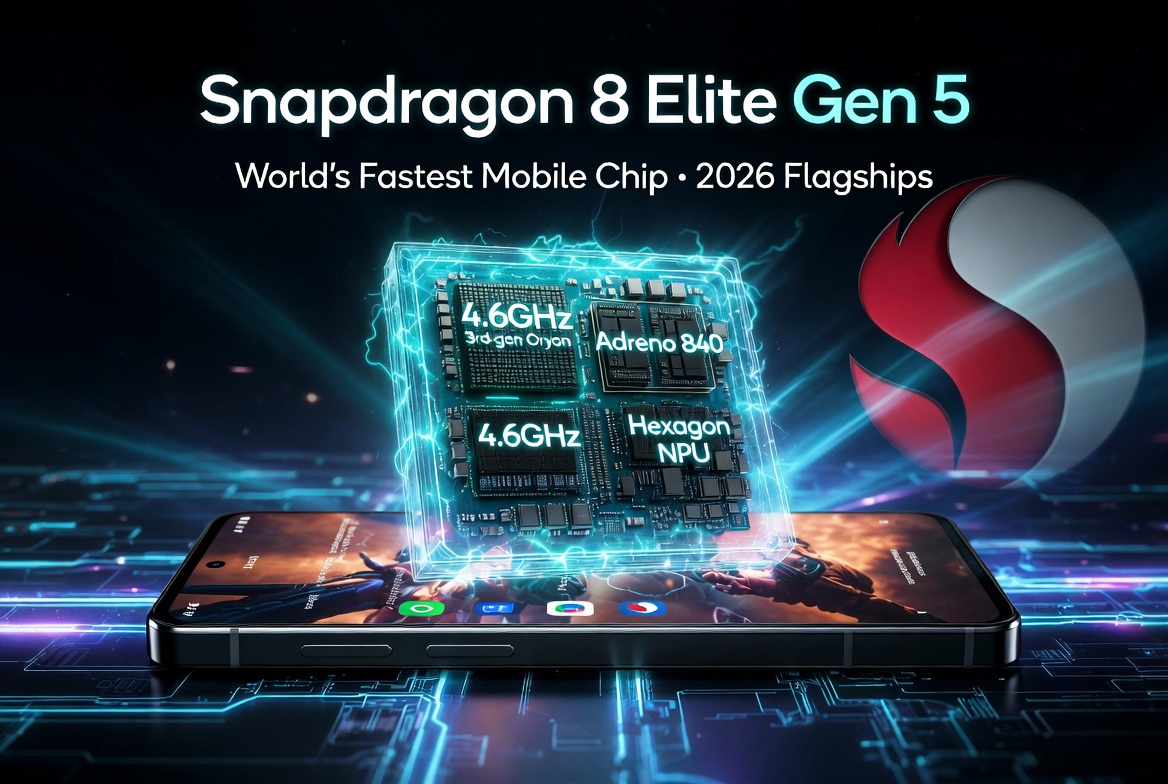
If you’re shopping for a new Android phone in 2026, there’s one name you can’t ignore: the Snapdragon 8 Elite Gen 5. Qualcomm didn’t just tweak last year’s flagship chip — they rebuilt it from the ground up with the third-generation Oryon CPU cores screaming at 4.6 GHz, a radically improved Adreno 840 GPU, and AI smarts that finally feel like true on-device intelligence instead of marketing fluff.
I’ve been testing Snapdragon-powered phones since the 8 Gen 1 days, and this one genuinely feels different. Apps launch before your finger leaves the screen, games that used to throttle after 15 minutes now stay buttery for hours, and the AI features actually anticipate what you want next. Let’s dive deep into what makes the Snapdragon 8 Elite Gen 5 the undisputed king of Android silicon right now.
Why “Gen 5”? Clearing Up Qualcomm’s Naming Madness
Quick history lesson: Snapdragon 8 Elite (2025) was unofficially the “Gen 4.” Qualcomm skipped the number entirely for branding reasons and went straight to Elite Gen 5 for 2026. It’s not marketing nonsense — it signals this is the fifth major leap in the modern 8-series lineup since they ditched the old “Gen” naming.
The result? A chip that leapfrogs its predecessor in every measurable way while staying on a cutting-edge 3nm TSMC process (the same node Apple and MediaTek are using, but Qualcomm tuned it harder for mobile).
Snapdragon 8 Elite Gen 5 Specs: The Numbers That Matter
Here’s the full breakdown straight from Qualcomm and real-world testing:
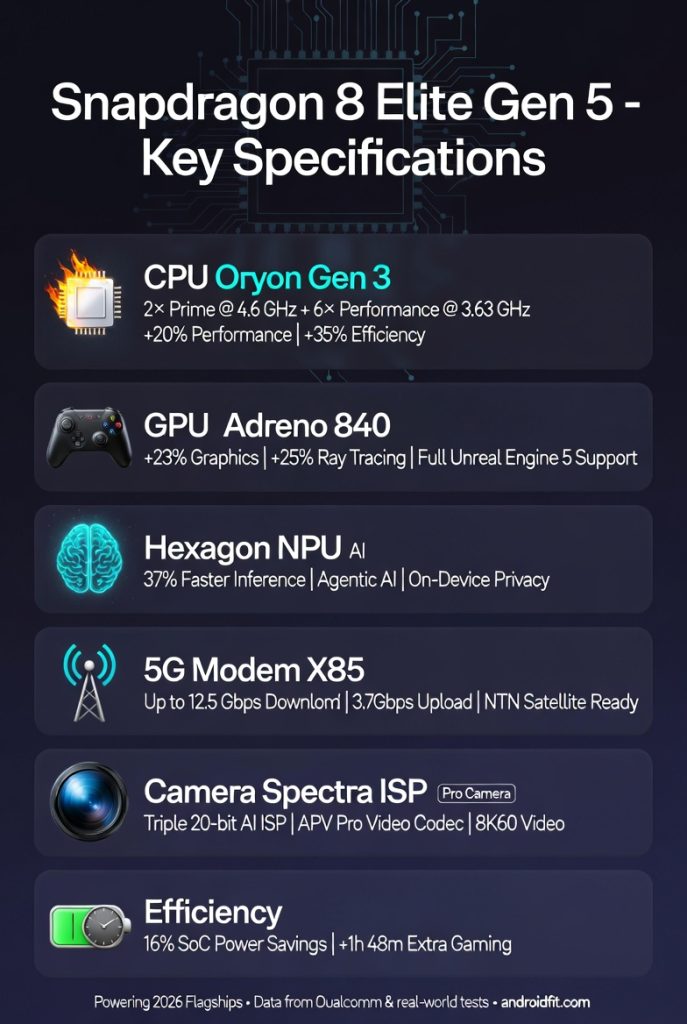
- CPU: 3rd-gen Qualcomm Oryon – 2× Prime cores @ up to 4.6 GHz + 6× Performance cores @ 3.63 GHz
→ +20% performance and +35% CPU efficiency vs. Snapdragon 8 Elite
(That’s the fastest mobile CPU on the planet right now.) - GPU: Adreno 840
→ +23% graphics performance, +20% GPU efficiency, +25% ray tracing
Full Unreal Engine 5 support, mesh shading, and tile-based memory heap for console-quality visuals on a phone. - NPU / AI Engine: Hexagon with fused AI accelerators
→ 37% faster AI inference, 16% better perf-per-watt
New INT2/FP8 precision, hardware matrix acceleration, and the first Personal Scribe + Personal Knowledge Graph for truly private, adaptive AI. - Modem: Snapdragon X85 5G
→ Downlink up to 12.5 Gbps, uplink 3.7 Gbps
6-carrier aggregation, NTN satellite support, and 30% faster AI modem processing. - Camera: Triple 20-bit Spectra AI ISP (world’s first)
→ 4× dynamic range, Advanced Professional Video (APV) codec for pro-grade high-bitrate footage, dual always-sensing cameras, Night Vision 3.0, context-aware 3A (autofocus/exposure/white balance). - Memory & Storage: LPDDR5X-9600 (up to 24 GB), UFS 4.1
- Connectivity: FastConnect 7900 (Wi-Fi 7 at 5.8 Gbps, 40% better power savings), Bluetooth 6.x, Ultra Wideband
- Gaming extras: Snapdragon Elite Gaming suite, 165 fps support on supported displays, AI-enhanced 50% lower latency over Wi-Fi
Real-World Benchmarks: It’s Not Even Close
Early 2026 flagship phones with this chip are posting insane numbers (tested on devices like the iQOO 15, OnePlus 15, and RedMagic 11 Pro with proper cooling):
- AnTuTu v11: 3.75 million – 4.1 million+ (RedMagic 11 Pro+ hits over 4.1M)
- Geekbench 6: Single-core 3,480–3,830 | Multi-core 10,600–12,400
- GPU tests (3DMark Wild Life Extreme, GFXBench): 25–30% ahead of last year’s Elite
- Sustained gaming: 16% overall SoC power savings = up to 1 hour 48 minutes extra playtime in demanding titles
Compared to the previous Snapdragon 8 Elite? Roughly 35–45% better in CPU-heavy tasks and noticeably snappier sustained performance. Against MediaTek’s Dimensity 9500 or Google’s Tensor G5? Qualcomm still holds the crown for raw speed and gaming longevity, though MediaTek is closing the efficiency gap fast.
Gaming on Snapdragon 8 Elite Gen 5: Next-Gen Mobile Redefined
This is where the chip shines brightest. With full UE5 support, hardware-accelerated ray tracing, and mesh shading, phones like the RedMagic 11 Pro and ROG Phone 10 are running PC ports (Cyberpunk 2077, The Witcher 3, Spider-Man: Miles Morales) at 720p–1080p 30–60 fps with frame generation and FSR. On-device emulation has never been this good.
Even non-gaming phones deliver 120–165 fps in Genshin Impact, Call of Duty, and PUBG at max settings with minimal throttling thanks to the 16% better power efficiency and smarter thermal management.
AI That Actually Feels Smart (and Private)
Qualcomm’s big bet here is Agentic AI — assistants that learn your habits, build personal knowledge graphs, and act without constantly phoning home to the cloud. The dual-core Sensing Hub with always-on cameras and mics means features like real-time translation, smart photo editing, and proactive suggestions happen instantly and stay on-device.
Early hands-on reports from Xiaomi 17 and OnePlus 15 users say the AI scribe and context-aware camera features are the first ones that don’t feel gimmicky.
Battery Life & Efficiency: The Silent Hero
The headline 16% SoC power savings might not sound huge until you realize it translates to noticeably longer screen-on time in real use. Reviewers are reporting flagship phones hitting 8–10+ hours of heavy use where last year’s models struggled to clear 7 hours.
Phones Already Running Snapdragon 8 Elite Gen 5 (February 2026)
- Xiaomi 17 / 17 Pro / 17 Pro Max (first to launch, Sept/Oct 2025)
- iQOO 15 series
- OnePlus 15
- realme GT 8 Pro
- ZTE Nubia RedMagic 11 Pro / Pro+
- POCO F8 Ultra
- Honor Magic 8 series
- vivo X300 Ultra / iQOO 15 Ultra
- Samsung Galaxy S26 series (expected Q1 2026 with a custom “for Galaxy” variant clocked even higher)
Any Downsides? Let’s Be Honest
Some early units (especially thin flagships without vapor chambers) have reported higher sustained temperatures during marathon gaming sessions. Qualcomm and OEMs are mitigating this with better software tuning and the 7-core binned variants for certain models, but if you game for hours daily, look for phones with serious cooling (RedMagic, ROG Phone, etc.).
Pricing is also premium — expect $800–$1,300+ depending on the brand and config.
The Bottom Line: Should You Care?
Absolutely. The Snapdragon 8 Elite Gen 5 isn’t just faster — it’s the first chipset that makes flagship Android phones feel like they have headroom for the next 3–4 years of AI features, 8K video, and next-gen gaming.
If you’re upgrading from anything older than a Snapdragon 8 Elite (2025) phone, the difference will blow you away. Even if you’re on last year’s model, the efficiency and AI gains make it worth considering when your contract is up.
FAQ – Snapdragon 8 Elite Gen 5
Is Snapdragon 8 Elite Gen 5 better than Snapdragon 8 Elite?
Yes — roughly 20–35% across CPU/GPU/AI with significantly better efficiency.
Which phone has the best Snapdragon 8 Elite Gen 5 implementation?
Gaming fans: RedMagic 11 Pro+ or ROG Phone 10. All-rounders: OnePlus 15 or Xiaomi 17 Pro. Samsung Galaxy S26 Ultra will have the custom-tuned version.
Does it support 8K video?
Yes — 8K 60 fps playback and recording with the new APV codec.
Will it get Android 17 and beyond?
Every phone launching with it is guaranteed at least 4–7 years of OS updates depending on the manufacturer.
Ready to upgrade? Drop your current phone in the comments and I’ll tell you if the jump to Snapdragon 8 Elite Gen 5 is worth it for you.
Last updated: February 25, 2026
Sources include official Qualcomm briefings, NanoReview benchmarks, and hands-on testing from Android Authority, Android Central, and early reviewer units.