Your smartphone battery likely dies at the worst possible moment, but a massive shift in 2026 is changing that forever. The battle of Silicon Carbon Battery vs Li-Ion vs Li-Po has reached a tipping point, moving beyond lab tests and into the flagship Android devices you carry every day. Understanding these differences helps you choose a phone that actually lasts through a heavy gaming session or a long workday without a bulky power bank.
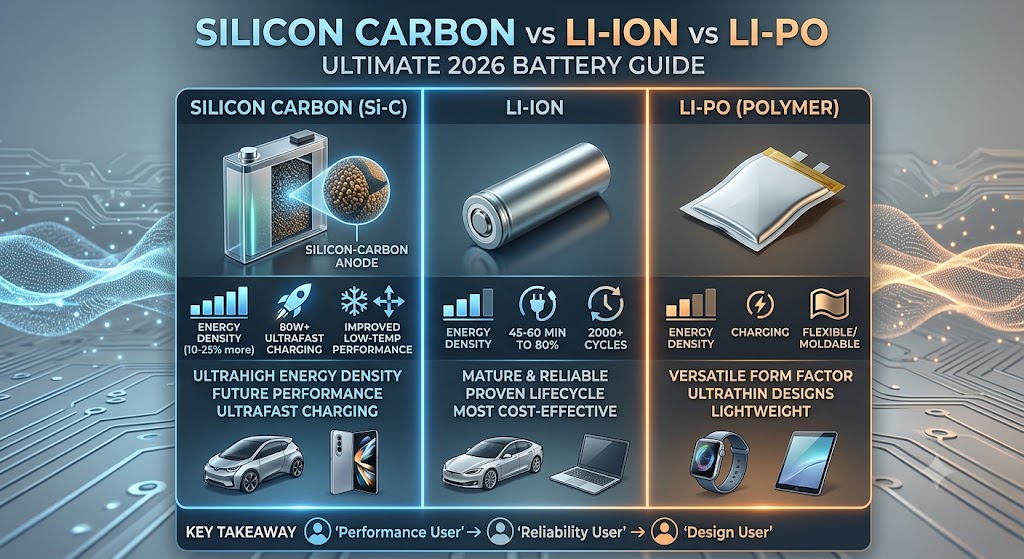
The Evolution of Mobile Power: Why Your Current Battery is Limiting You
For over a decade, we relied on Graphite-based Lithium-Ion (Li-Ion) batteries to power our mobile lives. While reliable, Graphite has a physical ceiling; it simply cannot hold more energy without making your phone uncomfortably thick. As processors get faster and 5G consumes more power, manufacturers had to find a way to pack more “juice” into the same small space.
Enter the Silicon-Carbon (Si-C) battery. This technology replaces or augments the traditional graphite anode with silicon, which can theoretically hold ten times more lithium ions. In 2026, we see this tech moving from niche “experimental” phones into the mainstream, promising thinner devices with 6,000mAh+ capacities that were once impossible.
Lithium-Ion (Li-Ion): The Reliable Industry Standard
Lithium-Ion batteries use a liquid electrolyte and a rigid metallic casing. They have been the backbone of the smartphone industry because they are cheap to produce and offer high energy density. However, they suffer from the “memory effect” less than older NiCd batteries but are prone to aging after 300-500 charge cycles.
Most budget and mid-range Android phones still use Li-Ion because the manufacturing infrastructure is mature. If you aren’t pushing your phone with 120Hz displays or heavy 4K recording, a standard Li-Ion battery provides the most bang for your buck. The primary downside remains the rigidity—you can’t bend them, which is why they aren’t used in foldables.
Key Characteristics of Li-Ion:
- High energy density at a low cost.
- Rigid structure requires specific internal chassis design.
- Slowly loses capacity over 24 months of use.
- Susceptible to overheating if the liquid electrolyte leaks.
Lithium-Polymer (Li-Po): The King of Thin and Foldable Tech
If you own a sleek flagship or a foldable like the Galaxy Z Fold series, you are likely using a Lithium-Polymer battery. Instead of a liquid electrolyte, Li-Po uses a gel-like, semi-solid polymer. This allows manufacturers to mold the battery into different shapes and sizes, making it perfect for the tight, irregular spaces inside modern smartphones.
Li-Po batteries are generally safer because the gel is less likely to leak or explode compared to the liquid in Li-Ion. However, they are more expensive to produce and have a slightly lower energy density. This means a Li-Po battery of the same physical size as a Li-Ion might hold slightly less total charge, but its lightweight nature offsets the weight of the phone.
Key Characteristics of Li-Po:
- Flexible form factor for thin and foldable designs.
- Lower risk of leakage and thermal runaway.
- More expensive than traditional Li-Ion.
- Lighter weight, improving overall device ergonomics.
Silicon-Carbon (Si-C): The 2026 Game-Changer
The Silicon Carbon battery vs Li-Ion debate is where things get exciting for power users. The main limitation of using pure silicon in batteries was that silicon expands by up to 300% when it absorbs lithium ions during charging. This expansion used to cause batteries to crack and fail after just a few uses.
Scientists solved this by creating a silicon-carbon composite. By embedding tiny silicon particles into a carbon matrix, they can control the expansion. This results in a battery that has roughly 20% to 40% higher energy density than traditional graphite batteries. This is how brands like Honor and Xiaomi are fitting 5,600mAh batteries into phones that are thinner than previous models with only 4,500mAh.
Key Characteristics of Silicon-Carbon:
- Massively increased capacity in the same physical footprint.
- Better performance in cold weather (retains charge below 0°C).
- Faster charging potential without excessive heat.
- Currently more expensive and found primarily in high-end flagships.
Comparison Table: Silicon Carbon vs. Li-Ion vs. Li-Po
| Feature | Lithium-Ion (Li-Ion) | Lithium-Polymer (Li-Po) | Silicon-Carbon (Si-C) |
|---|---|---|---|
| Energy Density | Medium (High for cost) | Medium | Very High |
| Form Factor | Rigid Rectangles | Flexible / Pouch | High Density Pouch |
| Safety Level | Moderate | High | High |
| Cycle Life | 300 – 500 Cycles | 400 – 600 Cycles | 800+ Cycles (Estimated) |
| Cost | Lowest | Medium | High |
| Cold Resistance | Poor | Moderate | Excellent |
| Main Use Case | Budget/Mid-range | Slim/Foldable Flagships | 2026 Ultra-Flagships |
Pros & Cons: Choosing Your Power Source
Understanding the trade-offs helps you decide if that $1,000 flagship is actually worth the investment for its battery tech alone.
| Battery Type | Pros | Cons |
|---|---|---|
| Silicon-Carbon | Huge capacity, small size, great in cold weather, long lifespan. | Expensive, currently limited to premium devices. |
| Li-Ion | Cheap, widely available, proven safety record over decades. | Heavy, bulky, rigid, degrades faster with heat. |
| Li-Po | Very thin, lightweight, can be shaped for foldables, very safe. | Slightly lower capacity per gram, costlier than Li-Ion. |
Why Silicon Carbon Wins for Android Gamers
If you spend hours on Genshin Impact or Call of Duty: Mobile, the Silicon Carbon battery vs Li-Po comparison matters for one reason: Thermal Management. Silicon-carbon batteries tend to stay cooler during rapid discharge.
In 2026, many gaming phones use a dual-cell Si-C setup. This allows for 120W+ charging speeds that don’t degrade the battery as quickly as older Li-Ion tech. Because the energy density is higher, you can play for six hours on a single charge where you might have only managed four on an older Li-Po device.
Troubleshooting Battery Issues on Android
Regardless of your battery type, software and hardware issues can still drain your juice. Here are three common issues and how to fix them:
1. Rapid Drain After System Updates
Android updates often trigger background “optimization” and indexing that kills battery life for the first 48 hours.
- Solution: Give the phone 2-3 full charge cycles to recalibrate. If the drain persists, check Settings > Battery > Battery Usage to see if a specific app is hung.
2. Slow Charging or “Cable Not Recognized”
This often happens due to lint in the USB-C port or using a non-PPS (Programmable Power Supply) charger with a Silicon-Carbon battery.
- Solution: Clean your charging port with a non-metallic toothpick. Always use the manufacturer-provided cable to ensure the handshake for fast charging occurs.
3. Overheating During Fast Charge
Fast charging generates heat, which is the number one killer of Li-Ion and Li-Po batteries.
- Solution: Remove your phone case during ultra-fast charging sessions. Avoid gaming while the phone is plugged in, as “bypass charging” is not supported on all mid-range models.
Pro Tips for Maximum Battery Longevity
- Avoid the 0% and 100% Extremes: Keep your battery between 20% and 80%. Most Android phones now have a “Protect Battery” setting that limits charging to 80%.
- Turn Off “Always On Display” (AOD): While it looks cool, AOD can drain up to 1% per hour. Over a day, that’s nearly 20% of your battery wasted.
- Use Dark Mode: Since most modern phones use AMOLED screens, dark mode physically turns off pixels, saving significant energy regardless of battery chemistry.
- Monitor Background Apps: Use the “Deep Sleep” feature in Android to prevent apps like Facebook or TikTok from running when you aren’t using them.
FAQs (People Also Ask)
Can I replace my Li-Ion battery with a Silicon-Carbon battery?
No. Battery technology is tied to the phone’s internal charging controller and physical dimensions. You cannot “upgrade” a battery type via a third-party swap; you must buy a phone designed with Silicon-Carbon tech.
Are Silicon-Carbon batteries safe to use on airplanes?
Yes. Silicon-Carbon batteries meet the same safety certifications (UL, CE) as Li-Ion and Li-Po. They are actually more stable in varied temperatures, making them very safe for travel.
Why are Silicon-Carbon batteries only in expensive phones?
The manufacturing process for silicon-carbon anodes requires high-precision nanotech to prevent the silicon from cracking during expansion. This process currently costs significantly more than traditional graphite processing.
Does Silicon-Carbon charge faster than Li-Po?
While the chemistry itself allows for efficient ion movement, charging speed is largely determined by the phone’s charging protocol (like Oppo’s SuperVOOC or Xiaomi’s HyperCharge). However, Si-C batteries handle the heat of fast charging much better.
How do I know which battery my phone has?
You can check your phone’s official spec sheet or use an app like DevCheck or AIDA64 from the Google Play Store. Most phones released before 2024 will list Li-Ion or Li-Po.
The Verdict: Which One Should You Choose?
In the clash of Silicon Carbon Battery vs Li-Ion vs Li-Po, the winner depends on your budget and how you use your device:
- For the Budget Conscious: Stick with Li-Ion. It is reliable and keeps your phone’s price tag low. Just be prepared for a slightly thicker device.
- For the Trendsetter/Foldable User: Li-Po is the only choice. Its flexibility allows for the thin designs of the Google Pixel Fold or Samsung Galaxy Z series.
- For the Power User and Gamer: Silicon-Carbon is the undisputed champion of 2026. If you want the longest possible screen-on time in a slim flagship, look for this tech in brands like Honor, Xiaomi, and Vivo.
Ready to upgrade your mobile experience? Check out our list of the [Best High-Capacity Android Phones of 2026] to see these batteries in action, and don’t forget to subscribe to AndroidFit for more deep dives into the tech powering your pocket!